
CHICAGO, IL – June 4, 2026 – Pediatric medical devices lag over a decade behind those developed for adults, and children are often treated with medical devices that aren’t designed for their small anatomy or developed for their specific needs. The Consortium for Technology in Innovation & Pediatrics (CTIP) continually strives to change that by supporting innovative pediatric medical device companies from concept to commercialization via funding, advising, networking, and advocacy.
For the 2026 CPI Grant intake period, we received letters of intent (LOIs) from companies and individuals from 29 U.S. states with devices spanning 38 pediatric subspecialties.
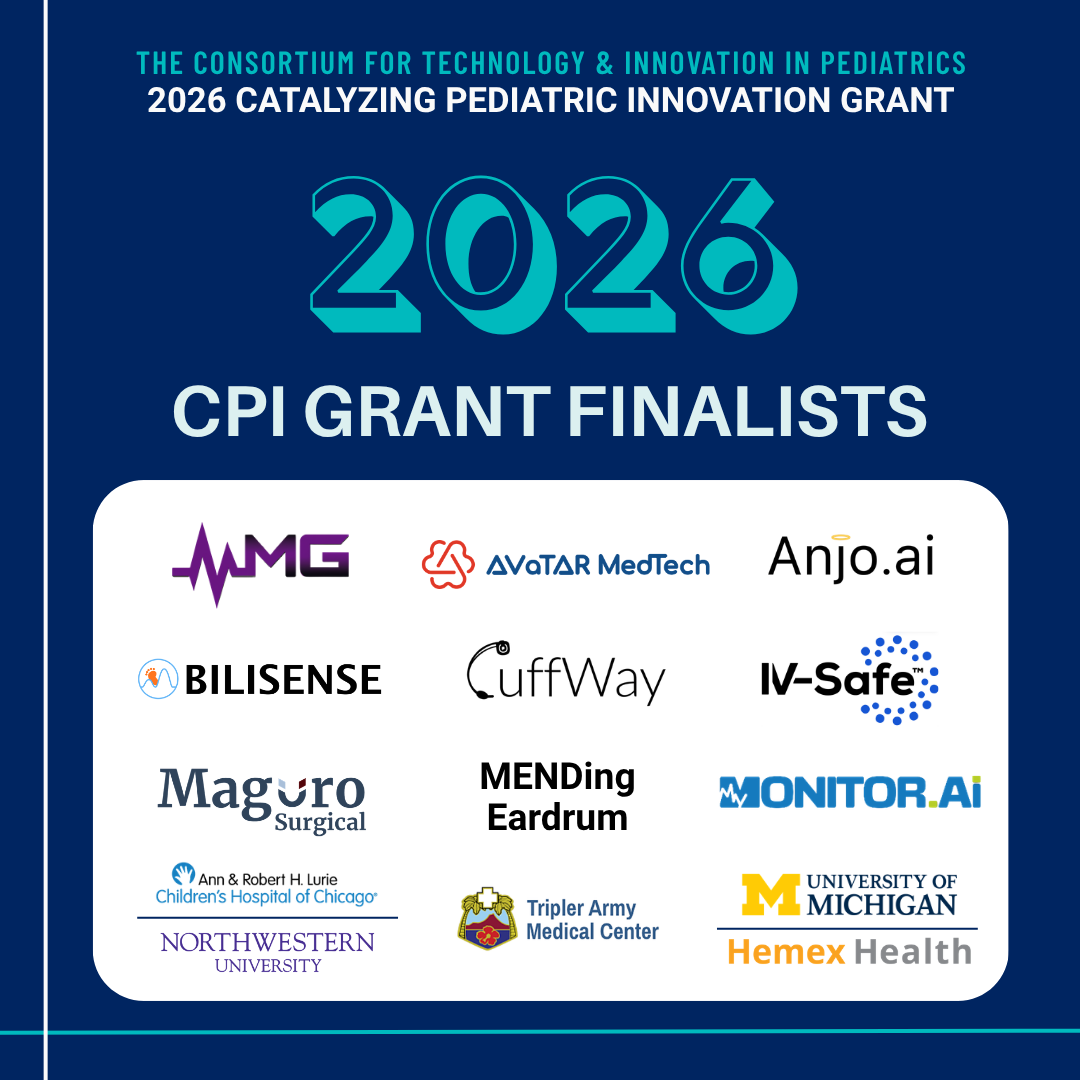
CTIP is proud to share the twelve finalists selected, listed below alphabetically:
AMG Detection, LLC
AMG Detection is developing The Joey, the world's first wearable seizure predictor, which uses a custom sensor array and AI to detect the pre-seizure chemical signature released from the skin up to 45 minutes before onset, giving patients and caregivers time to act before a seizure begins.
Anjo.ai | LinkedIn
Anjo.ai is developing a comprehensive allergy management and safety platform for families, including AI-driven, wearable-powered remote monitoring and early detection of anaphylaxis.
AVaTAR MedTech | LinkedIn
AVaTAR MedTech is developing a pediatric-first surgical approach consisting of a single-use surgical kit that enables surgeons to reconstruct living, native-like heart valves using the patient’s own pericardial tissue.
Bilisense | LinkedIn
Bilisense is developing a diagnostic tool for accurate, rapid, point-of-care measurement of total and fractionated serum bilirubin wherever physicians see neonates.
CuffWay | LinkedIn
CuffWay is the first and only automated, adaptive cuff pressure controller, continuously sensing and modulating pressure to match a pediatric patient's tracheal movement rather than holding a static setpoint. A reusable bedside unit integrates with any cuffed ETT, tracheostomy tube, or cuffed airway device through a disposable patient-specific tube set.
Northwestern University & Ann & Robert H. Lurie Children's Hospital of Chicago
Pediatric aspiration is an under-quantified condition. This team proposes a method for the quantification of pediatric aspiration via epi-fluorescent endomicroscopy of red fluorescent poly(lactic-co-glycolic acid) (PLGA) microspheres.
IV-Safe: Passive Chromatic IV Failure Detection for Neonatal and Pediatric Patients | Website
IV-Safe is a passive chromatic dressing that detects peripheral IV catheter failure in real time via a visible color change, protecting neonatal and pediatric patients from the complications of undetected infiltration and extravasation.
Maguro Surgical | LinkedIn
The MagStone System from Maguro Surgical is a first-of-its-kind magnetic retrieval device for endoscopic kidney stone fragment removal. The retrieval tool attracts all coated fragments for en masse removal. It is fully compatible with all ureteroscopes and ureteral access sheaths, including those used in pediatric patients.
MENDing Eardrum
MENDis a next-generation bioengineered extracellular matrix scaffold designed to improve eardrum repair by stimulating tissue regeneration.
MyMonitor.ai | LinkedIn
The MyMonitor Pediatric Smart Dermatoscope is a handheld, melanin-aware imaging device that enables standardized remote monitoring of pediatric skin diseases, helping clinicians make more objective and equitable care decisions across all skin tones.
Tripler Army Medical Center | LinkedIn
The patent-pending Bubble Bilevel Positive Airway Pressure Device is a low-cost, low-profile, noninvasive respiratory support system designed to improve access to lifesaving care for infants and children with respiratory distress in resource-limited settings, while also providing a versatile solution for ambulances, emergency departments, and pediatric intensive care units worldwide.
University of Michigan & Hemex Health
The clinical diagnosis of anaphylaxis is challenging, so this team has developed a device that enables rapid, noninvasive detection of proteins and antigens in biologic fluids, a feature that will be applied to detection of tryptase as a marker of anaphylaxis in saliva.
—
Stay up to date with the latest news from CTIP by signing up for our newsletter.
For more updates from CTIP about pediatric MedTech, follow us on LinkedIn and X.
Find us online at www.ctipmedtech.org.
The Consortium for Technology & Innovation in Pediatrics (CTIP) is an FDA-funded pediatric MedTech accelerator centered at Lurie Children’s Hospital (LCH) and Children's Hospital Los Angeles (CHLA). Our goal is to facilitate the development, production, and distribution of pediatric medical devices by identifying companies working in the space and providing advice, networking, and direct and indirect financial support on the road to commercialization.
Questions? Please contact us at info@ctipmedtech.org.